
Sensory
Sensory Accommodations
 Most children with ASD have difficulties with sensory integration that can seriously interfere with their ability to learn and concentrate. Even though Montessori materials are specifically designed to appeal to the child’s senses, students with ASD often cannot stay on-task for a long period of time. The sensory needs of children with ASD can be addressed with the so-called “sensory diet” – a menu of activities which are usually developed by an occupational therapist based on child observation. It is recommended that students with ASD take frequent sensory breaks to help them regulate their alertness, handle transitions, tolerate challenging sensations and increase their attention span. For example, it might be productive to employ breaks lasting 10-15 minutes at intervals of 1 or 2 hours.
Depending on individual sensory needs, a child may need either a calming input (if he tends toward hyperactivity) or an arousing input (if he tends to be tired and sluggish). A potential challenge is that a given activity can be stimulating for one child and calming for another depending on their individual sensory profile. As indicated below, many of the sensory diet activities recommended by occupational therapists can fit naturally into routines and jobs found in a Montessori classroom.
Inputs designed to be proprioceptive (sensations from joints, muscles and connective tissues that lead to body awareness) include:
- Heavy lifting, such as pushing and pulling weighted objects, or putting the chairs up on the desks, carrying books to the library, shoveling snow, vacuuming, washing table tops, raking leaves, etc.
- Deep downward pressure on the child’s shoulders and down his arms (my son’s favorite!)
- Creating a “burrito” by rolling the child in a blanket
- Using a squirt bottle to water plants, or clean house/classroom areas.
- High fives; push-ups against the wall, chair or floor (joint compression)
- Climbing on playground equipment of hanging from monkey bars (joint extension)
- Throwing and catching balls of different sizes or weights
- Squeezing objects (balls, wet clothes, rags) or popping bubble wrap
- Wrapping Theraband around the chair legs to provide additional input
Vestibular inputs (those impacting the sensation of head position or movement in space by the inner ear) include:
- Rocking in a rocking chair
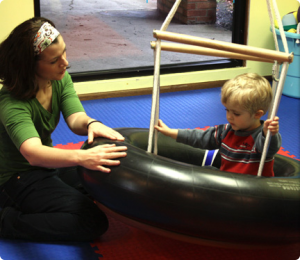
- Jumping on trampoline with two-footed jumps
- Rolling on top of ball or bouncing
- Swinging (linear is calming, rotary is arousing)
- Running, jumping or skipping
It is generally recommended that vestibular activities be followed by deep pressure, so that the child’s sensory system does not become over-stimulated.
Tactile activities (involve the sense of touch, texture or temperature) include:
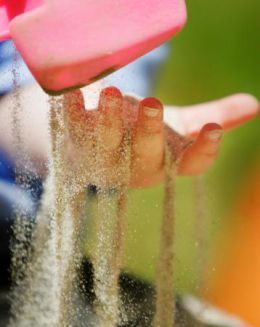
• Messy play with shaving cream, finger paint, or PlayDough
• Reading and touching textured books
• Tracing letters on sand paper
• Tracing shapes on to the child’s back or hand and asking him to guess the shape Oral motor activities include:
• Foods and drinks that incorporate sucking, munching, crunching, and chewing
• Alternating foods and drinks of different temperature and texture
• Blowing games, blow darts, blow pens, straw blowing games, bubbles, and whistles
• Gardening and repotting plants
• Sewing, weaving, sculpting or knitting
Oral motor activities include:
- Foods and drinks that incorporate sucking, munching, crunching, and chewing
- Alternating foods and drinks of different temperature and texture
- Blowing games, blow darts, blow pens, straw blowing games, bubbles, and whistles
For a more detailed overview of sensory integration disorder and sensory diets, click here
